Wednesday, December 24, 2008

Shopping

I miserably crawled awake at 3:00AM. I had always taken myself to be a great sleeper and never thought I'd have trouble with it, being as how it's one of my favorite things to do, but I guess I'm also a creature of habit who couldn't stay in bed past 12:00 noon in California. We had our usual breakfast of fruits and spent the day shopping. Bac Si Xuan, a close friend of Tung's family, is a retired doctor who now spends her days doing community service at local hospitals, taking care of ill Catholic priests. We eventually took to calling her Co ("Aunt") Xuan, as if she were family. She was very happy to hear that we were in town and took time from her especially busy schedule around Christmas to take us to Cho Ben Thanh, a famous marketplace in Saigon that existed when I was born and still thrives to this day, since so much of the Vietnamese economy relies on retail.


Ben Thanh has changed a lot since my youth. There are still 4 entrances: North, South, East, and West (the photo above shows the North entrance). In the past, it was comparable to An Dong Marketplace with its cramped stalls, narrow walkways, and pushy salespeople, but today's Ben Thanh caters to tourists and specifically sports signs prohibiting bargaining. Deep in its core, there are still those cramped stalls and merchants who would pull on your arm to get your attention, but the shops skirting the outer circumference of the market has a less chaotic ambience.

The stalls looked neater and were well laid out, and the salespeople were generally helpful and less pushy. While I'm sure my parents, who have been in retail all their lives, would prefer the bargaining leverage of An Dong, I must confess that I was much more comfortable with Ben Thanhs' culture.


After a brief walk around, Tung's family settled on a cloth merchant's stall and spent at least 3 hours there, choosing fabric for suits, pants, skirts, jackets, and casual wear--button-up shirts (called "ao so-mi") made from "vai ca-te," a thin, cool, moisture-wicking fabric popular in Viet Nam's balmy weather.


A lot of merchants sold pre-cut "ao dai" fabric in countless designs and styles, and I had so much fun picking out one (and eventually, two) for myself. Customers run their hands through the fabric, select a color, and choose a design, whereupon the salespeople take it off the hangers and hold it up to the customer's bodies so they can get a sense of how the design and color would look on them. They tirelessly repeat this cycle and even indulge window shoppers with this type of service in hopes of making a sale. Here I am, comparing fabric quality and design with Co Xuan, the woman in the lower-right.


I then took a break from shopping, with a coconut that was "on the house."


I eventually settled on a pale green, glittered flower design and a periwinkle (blue-violet) swirly design that Tung liked on me right away and insisted that I get. I also eventually gave in and bought Italian cloth for a pair of dress pants and a gray business suit.

The saddest sight around Ben Thanh were the people who went around trying to sell lottery tickets, especially to "Viet Kieu," we Vietnamese visiting from the US. Most of the lotto-ticket sellers were crippled, handicapped, or mentally impaired. Viet Nam's government does not provide Social Security income, handicap funds, or any other special services to aid them; they either have to learn to make it on their own, or rely on the aid of relatives for the rest of their lives.


And yet, they had such an amazing sense of pride, as if, used to such adversity, this small barrier is not enough to conquer their indomitable spirit. A lotto ticket costs $10,000 dong--less than 50 US cents. When Tung's mom wanted to buy a ticket but didn't have change, she tried to give the seller the whole $20,000 dong, but he told her that he wouldn't accept charity and would only take her money if she would buy two tickets in return.

There was also a boy, maybe in his teens, with Down's Syndrome. He passed by us several times on his rounds since Tung's family spent so much time at the same vendor. He was accompanied by a man (most likely his father), and the boy's tongue was so stiff that he could only force out a garbled bellow when he invited people to buy his tickets. His father was a decent man who recognized "no" as an answer and never allowed the boy to ask twice for a person to buy. Something about the unspoken love and dedication between a father and the son he was determined to see succeed brought tears to my eyes when the scene re-played itself in the middle of the night as I lay in bed.

That evening, after a brief respite at the hotel where we enjoyed to-go rice lunches from a nearby vendor (we are starting to gain confidence in our ability to tolerate the questionable food quality), we went back to An Dong to drop off our fabric to a tailor who did vests and suits. For someone used to buying clothes off store racks, cursing at the length of pants because they usually required alteration, getting a numbered ticket to a fitting room to try on the outfits, and buying generic sizes, the level of customization at the tailor's was like stepping into a different world. They were so well-versed in their profession that they took measurements faster than I could type a one-paragraph email. I was asked to pick from a catalog of styles, alter what's in the photos any way I'd like, customize a body-hugging or loose fit, and specify the style of my suit jacket and pants (straight-legs or boot-cut? With or without a button flap above the zipper? How many centimeters for the height of the button flap? What type of cut for my suit's lapel? Did I prefer two buttons or three down the vest?). Below, Di Ha (Tung's youngest aunt on his mother's side) is getting measured for her suit.


I couldn't wait to find how the suits would come out. I could seriously get used to this level of customization for my wardrobe.


Co Xuan took us to dinner at Sao Bien (Starfish), an outdoor restaurant with a mini playground and green lights projected to the tall trees, giving them a verdant glow. She said the place was popular for kids' birthday parties--hence, the playground. They also had a Christmas tree built out of empty Heineken bottles, which I discovered was popular not only in this restaurant but in other parts of Viet Nam as well.


Tung's family went to mass at 9:00PM with the hotel owners, who also invited them to a midnight meal. I had meant to go along to check out the night life on one of the busiest times of the year in Saigon, but I fell asleep to the sound of midnight church bells that heralded the coming of Christmas.


Tuesday, December 23, 2008

Family

Today we went to the market at 6:00AM with our hotel's landlady to buy fruits. The first ordeal was crossing the street; even in the early morning, motorbikes already thickened the narrow lanes. "Ped xings" and "pedestrian right-of-way" did not exist; yet somehow, amidst the chaos of a strange morse code of honking, pedestrians are supposed to magically integrate themselves into the flow and make it across at least four lanes of traffic. After the street-crossing adventure, we made it to an alleyway where merchants extended the front room of their houses into an open-air market. Fresh meat lay on wooden cutting boards, different grains of rice sat in colorful plastic bins, dried goods were spread out across table surfaces, barbecued chickens and ducks hung from metal hooks, and fresh fruits sat piled high in domes and pyramids.


We bought rambutans, custard apples, a type of banana called "chuoi xu" (or "chuoi xiem"), dragon fruit, "sa-po-che," and Vietnamese red plum. It's a real pity fresh fruits and seeds couldn't be brought back to the States.


After our fruit breakfast, we took a taxi to visit Tung's paternal grandmother. It was practically a surprise visit--Tung's dad called the day before we were set to arrive to tell the family that a "guest" was coming. Tung's grandma lives in a 3-room house. The front "guest" room was converted into a mini dining area for his aunts' business; every morning, they'd sell rice or egg noodles in broth ("hu tieu/mi") with chicken bought the evening before and refrigerated overnight. His aunt also ground fresh soy bean drink.


Tung's grandma didn't recognize him at first, but when she did, she hung on to his arm most of the time and made him sit by her side.


The small complex made me think of how I've always aimed for a 3-bedroom, 2-bathroom minimum house in the States. Yet four families live in this modest house; the shop front led in to the bedroom where several wall-mounted fans were turned on for us "guests" to circulate the air. The back-most room was a kitchen that contains a bathroom in the corner with a toilet. There is, believe it or not, a gutter in one of the kitchen corners that serves as a urinal. The "sink" for dishes is merely a second gutter under a different wall, where a protruding faucet delivers running water.

Several generations of Tung's family have lived in this house; his father grew up here. I wish I could communicate with Tung's grandma, but she speaks a special dialect of Chinese, and I could only use the meager sentences I gleaned from Mandarin lessons at work to say to her, "Nihao, Avaa" (Hello, Grandma), "Wo jong mei-gwoh lai" (I am from America), "Wo hway jiang ying-yew" (I speak English). The rest was up to Tung and his aunts and uncles to translate.

We left Tung's grandma's and toured around a famous market called An Dong. It's like a huge indoor Flea Market, but by noon and so close to Christmas day, the throng of local and tourist shoppers made it almost impossible to walk through. Here's the parking scene:


The clusters of shops were so close together that you could barely squeeze through unless you were a gifted contortionist. Merchants took breaks in-between sales to squat in front of a plastic table and enjoy a quick lunch of noodles in broth. They would speedily lay down their partially-devoured food to help a browsing customer in hopes of making another sale. Their lifestyle really makes America's typical 1-hour lunch break seem very lax. A million vendors pushed through the passing crowd to hawk their merchandise. With all the shoving and weaving through the crowd, pick-pocketing becomes a commonplace. After an immense bout of claustrophobia, we actually surrendered and hailed a taxi to get back to our hotel without attempting to buy anything.


At night, my Aunt Kieu Oanh ("Di Oanh," my mom's younger cousin, far right) arrived at our hotel to take us to an "ao dai" (Vietnamese traditional long dress) tailor. I got to customize the outfit by picking out the fabric color and sequin design. Di Oanh also paraded me around family, most of whom I had never met. Our taxi driver that night was a lively, sarcastic youth who cracked us up at every turn (literally) by telling entertaining stories of some of his more memorable customers. I met up with my Uncle Nhan ("Chu Nhan," far left in above picture) and his family, along with another of my mom's cousins, "Di Suong" (on my left in above picture) who told me stories about my mom's younger years, up to the time she got married with my dad and emigrated to America. These were stories I had never heard before, and it was so interesting to see that part of my mother through someone else's eyes. Instead of feeling alienated, these homely stories of a long-ago childhood and coming-of-age made me feel closer to her, as I saw how I inherited her temper, strength, and compassion.

Eventually, Chu Nhan drove us to his newly-built, 4-story house. That was the first time I had ever been in a house with its own elevator. The first thing we were led to was the house's flat roof, built with rails that were hugged by potted plants. The cool night breeze caressed my face as the neon lights of the city's night life winked at me from four stories below. The house was built with a private office for Chu Nhan and an overhead projector for board meetings.


The combination of work space and home life was so typical of Vietnamese estates, for my Ong Chu 2 (Chu Nhan's father and my maternal grandfather's younger brother) made sure to show me the ornate family altar in the main sitting room with framed photos of my deceased ancestors. I was almost 8,000 miles away from my house in California, and yet the serene, smiling faces of my relatives, including my grandpa's, gave me a warm sense of homecoming and a feeling of familiarity amid a sea of strangers.


Chu Nhan took us to Thien Thai restaurant for dinner that night, where french fries are strangely dipped in mayonnaise, but the restaurant does make the most memorable little seafood eggrolls. We ate under a pavilion in the cool night air, surrounded by a sea of lights strung up to welcome Christmas 2008.

Monday, December 22, 2008

Arrival

After almost 18 hours of flight time and a 1-hour layover at Taipei, Taiwan (which wasn't really an hour since we were rushing to board as soon as we got off the larger EVA plane), we finally landed in Ho Chi Minh City (Saigon), Viet Nam. The airport hasn't been fully rennovated, except for the runways, which I've been told underwent pretty significant paving for a smoother landing. However, the oblong runway surrounds an island of wild grass and weeds, grown tall from neglect. Occasionally strewn among the grass are stone walls, the kinds that look like they were used for military training back during the war.

When I got off the plane, I felt the last chills of a California winter melt away, replaced by a warm humidity that coats me like a second skin. I breathed in deep the scent of Viet Nam, and it occured to me that though I've been in this country before, this was the first time I've been on the Tan Son Nhat runway since my family left by boat.

The airport sported interesting cultural sights such as flight attendants in satin "ao dai"--blue long dresses with gold pants. A landscapist pushed an electric lawnmower, wearing a conical-shaped "non la" hat. Airport personnel jumped in to help us locate our luggages and stacked them on carts, gladly accepting tips for the service (when we've got 5 people in our party, 5 check-in luggages full of clothes, 5 check-in boxes full of gifts, 5 carry-ons, and a few purses, dishing out a nominal tip was completely worth it).


It was utter chaos when we stepped out of the airport, where a throng (and that's lightly putting it) of relatives, friends, tour service personnel, and cabbies were holding up signs and cramming all the way up to the windows from outside the airport to await the new arrivals. My first thought was, "What's going on?!" I felt like I was on the inauguration stage, with people waiting, people arriving, security guards patrolling, and endless taxi minivans pulling up to the curb and offering their services. You can bargain with the taxi drivers before you agree to ride with them, securing a flat rate instead of going by the typical taxi meters. We secured a ride to our hotel with all our luggage loaded and unloaded for approximately $15 US. Rides around town to local supermarkets and restaurants cost about $1-$3 US one-way. The distance to these places is pretty short to where we're staying, but our party takes taxi almost everywhere. Why? Because a typical family would own a few Vespas or Honda Dreams, not vans or sedans that are typically used for taxi services. And another reason. . .


This is your typical traffic scene in Ho Chi Minh City: utter chaos. Traffic lights and lane divisions are merely "suggestions," helmets are commodities, and everyone honks every other second. People on motor scooters pull up so close to the van that, had the windows been down, I wouldn't even have to extend my arm all the way to touch them. I've seen 7 rows of scooters and vans crammed into two lanes to wait for a green light. Tapping the horn was as second-nature to the Vietnamese as braking is to Californians during bumper-to-bumper traffic. We've had taxi drivers in stick-shifts more concerned with hovering over the horn than hovering over the brakes.


Our hotel room is clean, roomy, and quiet, with a lovely nautilus staircase leading up. We had a buffet dinner before we crashed for the night, a clean place with good food, seemingly catering to tourists. No stomach aches so far--a good sign. When we got back to the hotel, we crashed as soon as our heads hit the pillow. I thought I'd make up time for sleeplessness on the flight, but I only zonked out for 4 hours before waking up at 12:30AM (9:00AM PST).


Thursday, December 18, 2008

Frost


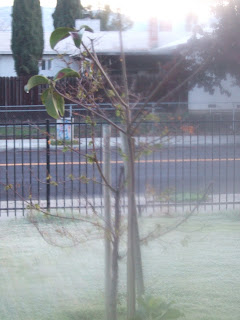
Here is a sight I won't see again for another 3 weeks: frost on the lawn, on roofs, and on cars, like a fuzzy dream on eyelids that are still coated with sleep. Current temperatures for Vietnam range from high's in the 90's and low's in the high-60's, with a 60% chance for scattered thunderstorms. Tomorrow I start packing: my t-shirts, shorts, sunblock, and a swimsuit for the beaches of Nha Trang and Vung Tau. I will take along with me a 30-pound box of souvenirs, a suitcase crammed with over a week's worth of clothing, and a mind loaded with advice from my parents. Places to visit. People to meet. Desserts to savor. Regional specialties to try. Fruits to taste again after 24 years of being away.


We pack heavy, but once there, touring the streets of Vietnam, we travel light, giving up pockets and purses crammed with electronic devices such as PDA's and multiple cell phones for one traveler's wallet worn around the body. Tomorrow I will strip off my gold rings and necklace and exchange my hoop earrings for studs, taking off the weighted metals that adorn my body until, with my new sense of buoyancy, I feel--at last--ready to fly.


Sunday, December 7, 2008

House


I was 6 years old when I saw Santa Claus for the first time, and 8 when I got my first birthday present. I've only carved my first Halloween jack-o-lantern a few years ago. And this past weekend, I made my first gingerbread house. I'm a late bloomer when it comes to adapting to the American culture, but perhaps being exposed to all these things at a later age made me more acutely aware of the essence behind these activities and not just that Americans do them for fun.

My parents never told me stories about St. Nick, so my first exposure to him was when a man with a pillow-stuffed belly came to visit our kindergarten classroom in a red-felt suit and a fake white beard, dragging along a bulging cloth sack. I was a little wary of him but did as I was told and got in line with my classmates to wait my turn sitting on his knee. I hadn't learned much English by then, but this is what I remember: Santa asked me in a disguised, deep-throated voice, "And what do you want for Christmas, little girl?" I told him I didn't know. "Well, every child usually wants something for Christmas! And you'll get something--reach in Santa's bag there and pick out anything for yourself."

My kindergarten teacher, Mrs. McKinley, taught us that Christmas was a time of giving, but I didn't have anything to give my mom. So I rummaged through the bag, looked past all the toys, and picked out an oversized tortoise-shell-colored bangle bracelet. When I came home from school that day, my cousin who was in my same class (and whom I lived with at the time) sported a family of wooden ducks he could drag behind him on a string. I went up to my mom, took out the bracelet, and told her, "Mommy, I got this for you. For Christmas." Eight years later, when I rummaged for my missing socks in my parents' dresser, I saw the bracelet where my mother had saved it--nestled among mismatched cotton socks in their sock drawer.

The jack-o-lantern and gingerbread house, I didn't start doing until after I met Tung. He was the one who tangled his fingers in yarn and awkwardly held up two knitting needles in an effort to figure out the instructions with me when I first learned to knit; the one who scraped pumpkin guts onto newspapers and etched out the design on my pumpkins; the one who tolerated sticky icing oozing along his hands as we pieced together our first gingerbread house.


Here's the house with all the panels cemented together with icing.


Here's me icing the roof.


Here's Tung, two seconds after he happily said, "I'm so glad this ice-piping bag has held up..."


Here's our progress at the end of Day 1.


Day 2: Tung outlines the front door.


And viola! Our completed gingerbread house.


The back of the house, sporting a crooked, automatic garage door and a window. This is a gated community, so secure even the residents won't be able to sneak their own car out of the gumdrop fence.


Mmmm, gingerbread...


That colorful house evokes a warmth of spending time putting together something creative with loved ones, of the sweet smell of icing, and of laughing over busted icing bags, sagging windows, and crooked doors. Maybe someday soon, Tung and I could stop playing pretend, when we will finally be able to buy a house and create a home of our own.

Saturday, December 6, 2008

Gifts

Both Tung and I still have family back in Vietnam, and it's customary to bring back gifts when we visit. I'm allowed two check-in items at a max of 50 pounds each, and already I'm beginning to wonder how I'm going to fit it all. I'm counting on my mom's list of which gifts go to which relatives--some of whom I have never met before. The items that I am somehow miraculously going to fit into my check-ins:


  1. Hawaiian Host chocolates. The Vietnamese are usually impressed with a gift of chocolates, since it's quite expensive in Vietnam. Good thing we are going in the cooler season--these guys are sure to melt in the humid 90-110-degree-F average temperature in the warmer months.

  2. Ferrero Rocher chocolates. See #1.

  3. Value pack of Reese's, Hershey's, Crunch, and Kit-Kat. See #1.

  4. Bath & Body Works body cream and shower gel. Cosmetics from the USA are especially coveted. Actually, anything with a "Made in the USA" stamp is coveted. When I was an infant, my maternal grandparents sent me Similac baby formula from the States.

  5. "Classic Mix" Frito Lay's snack-size chip bags. My dad insists they'll like it. I thought cheese stank upon first coming to the U.S., but okay. It took me a few months to like Doritos' nacho-cheese chips and maybe a year before I could stomach pizza.

  6. Eagle Brand menthol oil, a type of eucalyptus topical treatment for aches and pains. The Vietnamese, especially the older folks, use it for everything. Headaches, body aches, stomach aches, arthritis, to treat cuts (I'm not sure you're even supposed to apply to an open wound, by they do). I find the smell to be rather unpleasant and always associate it with elderly, sickly folks, kinda like mothballs to Americans.

The shrimp chips and freeze-dried fruits--those are just mainly for our snacking pleasure on the long flight. Tung was pretty indignant on going hungry for long ours before they managed to pass out the meals on his last flight to Vietnam, about 5 years ago.

Monday, December 1, 2008

Dong


The current rate of exchange from U.S. dollar to the Vietnamese "dong" is $1 to 16,930. Suddenly I picture myself standing calculator-less at a sidewalk merchant's stall, gaping at my own inefficiency to perform mental math with such a seemingly odd sum. The dong has undergone dramatic inflation, and the cost of a simple meal could be in the hundreds or thousands. I heard the food portions are quite small in comparison to American standards (no "super-sizing" there), so it'd usually take double the order to fill you up.

Last night I finished reading my guide book, The Insight Pocket Guide: Vietnam. Don't ever read it--it's awful. The author is too opinionated and makes at least a dozen references to Graham Greene's novel, The Quiet American, as if that's the single, most important piece of literature ever to be associated with Viet Nam. I haven't read the novel, so I can't say if it's that good, but I could say that the author of my guide book relies too heavily on a piece of fiction to back up a work of nonfiction, and her references are lost on those who have not read Greene's novel. There's not enough practical advice for a first-time visitor of Viet Nam. Maybe I'm expecting too much from a guide book. Maybe I'm just eager to see for myself what it's like, to embrace the trip with the heart instead of just a cerebral account of famous tourist spots.