It’s not the best shomen out there—not the fanciest or well decorated or grandest. It is “Ai Ki Do” calligraphy, signed by the artist, resting in a simple wooden frame. It’s not even permanently fixed, as we share our dojo with wrestlers and sometimes out-of-town sports visitors of the private high school in which we’re situated. In a given week, it would come off and on the wall many times to either accommodate our aikido training or make room for the wrestlers who also frequent the gym. But our shomen has been there for as long as I have joined the dojo, and its presence stretches back as far as when the now-yudansha were still wearing their white belts. Captured in photographs from the past, it stands slightly out-of-focus, regal and serene, like an observer in the background presiding over all our belt tests across time.
One Saturday, our morning class was booted to training outdoors as some out-of-town visitors practiced wrestling in the gym. After they left, we discovered that someone in their crew had taken our shomen with him. It was a tiny thing, but its absence was literally and figuratively an emptiness in the room. Not only did it serve as a reference point for our line-up and bow-in, it was my focal point when I first started. I tried to shake off the wrestling-room décor and the bizarre Biblical quote painted on the far wall to adapt the “empty cup” zen mentality more conducive to my aikido. I studied the characters, I memorized the strokes. I tried to visualize how the artist’s brush movements and energy could mirror my own as I trained.
We waited for a week, and our shomen didn’t make its way back to the dojo, so we put up a new one in its place. This one is smaller, more modern, with the same “Ai Ki Do” characters written in a different hand. It is bordered by a square black frame, and at some angles, the glossy glass reflects a glaring amount of light.
Maybe it’s the onset of hotter, muggier summer days. Maybe it’s the major-overhaul construction that they’ve been doing to the parking lot and blacktop areas of the high school grounds. Maybe it’s the broken concrete and debris stacked waist-high right across from the dojo that makes the entire place look like a garbage dump, or that awful smell of cooking tar in the cauldrons right at the entrance, blowing toxic fumes into the air as we train. But since the original shomen went missing, there has been a slowness to my training. A busy schedule has been breaking up my rock-solid, four-times-a-week participation. When I do go, I still enjoy myself, but there’s a part of me that feels withdrawn. I am not as energetic and enthusiastic, and the laughter that keeps it fun does not come as easily.
I know I carry aikido in my heart, and, like my writing, it’s this unique thing that I can take with me wherever I go. “That part of you will never go away,” a good friend had told me once when I confided that I was afraid of losing my creative writing skills. So I tell myself that when I step onto the mat. I push past the discomfort and languidness. And I’d like to believe that even though his original physical representation is missing, the spirit of O-Sensei hovers over us all, like a regal observer standing in the background, watching.
Friday, July 16, 2010

Wednesday, July 7, 2010
Shelves
It's amazing how messy things can get without proper storage. Here are binders, folders, papers, and files all over my office floor.


Tung and his dad put in these shelves in one of the double-door closets. The precision-drilled holes are creatively a courtesy of reusing the hutch of the computer desk.

Here's most of the stuff off the floor. . .

. . .and neatly tucked away on the new shelves. Ahhh, cleanliness.

Tuesday, July 6, 2010
Curtains
Curtain Hanging 101: First find the stud in which to drill.

Curtain hardware for the triple-valance rod. It's actually even more complicated than it looks, especially when some rods are konked out and the connecting mechanisms don't fit into each other without a little "plier persuasion."

Here is the first sheer curtain layer. This is the most elaborate set, in the dining room.

Here is the second main layer. The triple-valance rod is missing the third and last curtain layer, an overhanging valance with tassel-trim details.

Here is the last layer, with gold-trim detailing and ivory tassels for tiebacks.

Add the perfect accent for the guest area, a mahogany-colored coffee table to match the trim of the sofas.

Here is the Master Bedroom curtain set, a leaf-print thick layer over white sheers. Curtain hold-backs are used for a split effect in the middle. Great for blocking out most of the direct sunlight while still allowing a view out to the garden.

This is the set for the guest bedroom, same curtain prints but with a different curtain rod design.


Curtain hardware for the triple-valance rod. It's actually even more complicated than it looks, especially when some rods are konked out and the connecting mechanisms don't fit into each other without a little "plier persuasion."

Here is the first sheer curtain layer. This is the most elaborate set, in the dining room.

Here is the second main layer. The triple-valance rod is missing the third and last curtain layer, an overhanging valance with tassel-trim details.

Here is the last layer, with gold-trim detailing and ivory tassels for tiebacks.

Add the perfect accent for the guest area, a mahogany-colored coffee table to match the trim of the sofas.

Here is the Master Bedroom curtain set, a leaf-print thick layer over white sheers. Curtain hold-backs are used for a split effect in the middle. Great for blocking out most of the direct sunlight while still allowing a view out to the garden.

This is the set for the guest bedroom, same curtain prints but with a different curtain rod design.

Sunday, June 20, 2010
Storage
So how has the house been going lately? We spent the weekend assembling storage units for various messy things just lying around the house. First off, here is how Tung opens a box. If we happened to have missing parts, we'd have been screwed. No way we're returning this.

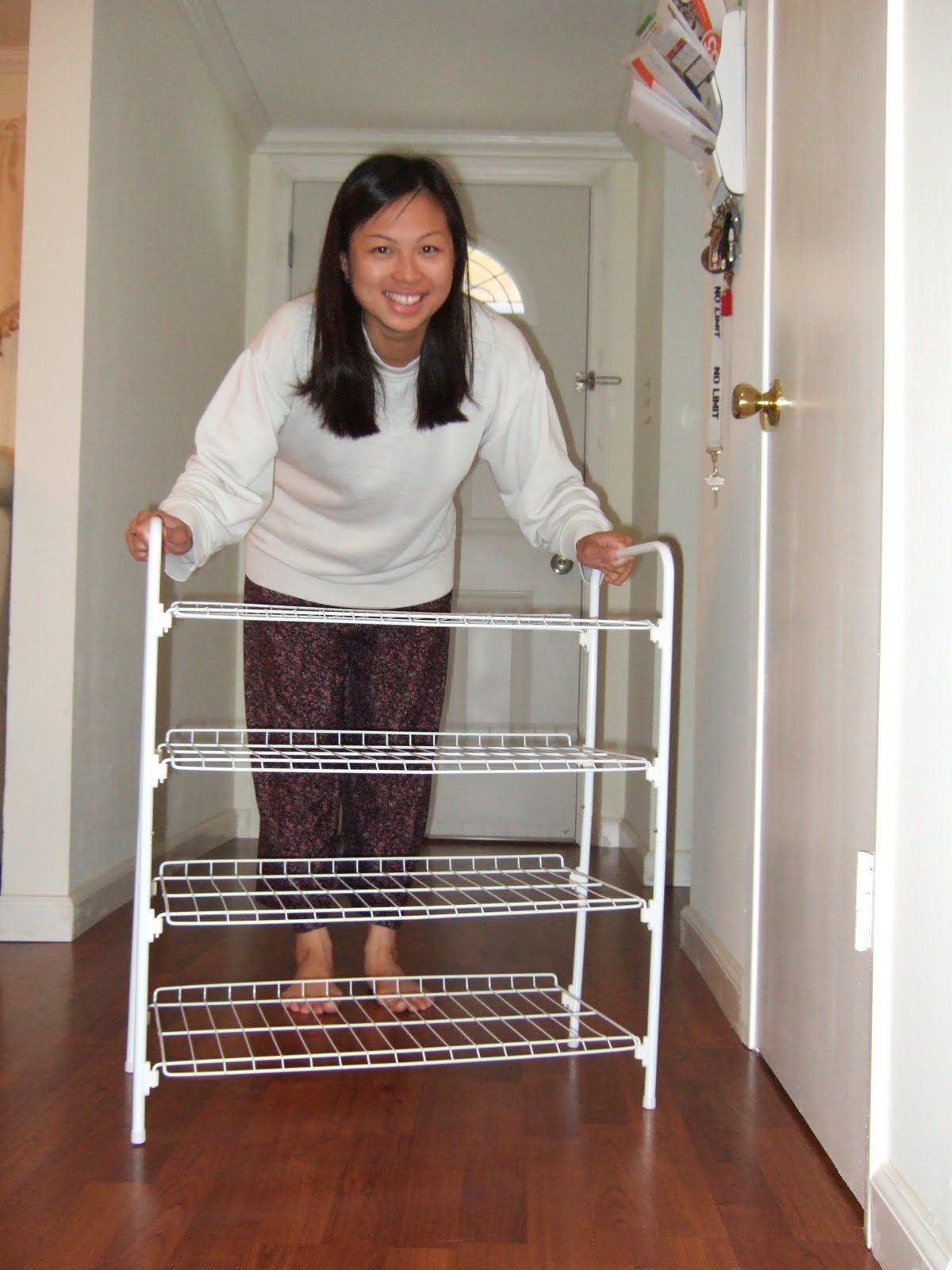
I put together this shoe rack, all by myself! Well, it was one of those easy "no tools required" assemblies, plus I was trying to do my due diligence as a Tech Writer by reading the instructions, when in the middle of my RTFM moment, Tung wanted to take over, but aside from his assembly of one of the legs, I did do the rest by myself. So do I look like an old lady with her shoe rack support here?

Here's Tung's "Awww, why does Daisy make me work on house stuff on my weekends all the time" face:

Yes, he's thrilled to be assembling storage units. Anyway, off to work.

I was told two-and-a-half hours later when I returned to the house from a few errands that this particular cabinet was put together with a more-than-normal amount of cussing due to the stupidity of the way the instructions were written--which were later ripped to tidbits due to spite. Something about the confusion with the "top shelf" and "static shelf" so that the tally of hours Tung spent on it went approximately like thus:
1 hour: partial assembly
0.5 hours: cussing over mixing up the two shelves
1 hour: taking apart mistake and re-assembling
Well, we can't all have our Tech Writer girlfriends write up our instruction manuals, now, can we?
So here's a shot of our ghetto-rigged phone table before: one of our moving boxes that looked like it was barfing multi-colored electric cables all over itself while it crapped shoes on the floor.

Here's the "After" shot of the (aforementioned pain-in-the-butt) cabinet/phone table. Yes, I still use a land phone.

And the shoes are neatly stored on my new shoe rack.

Here's the "Before" shot of what happens when you've got no place to put your media.

Viola! New shelf built for music and movie library, plus a media cabinet for the stereo, VCR/DVD player, Playstation, and soon-to-be Wii console. Still kinda messy with the wires, but in due time, when I can get Tung to make another "why do I have to do this" face, we'll get that tidied up soon enough.

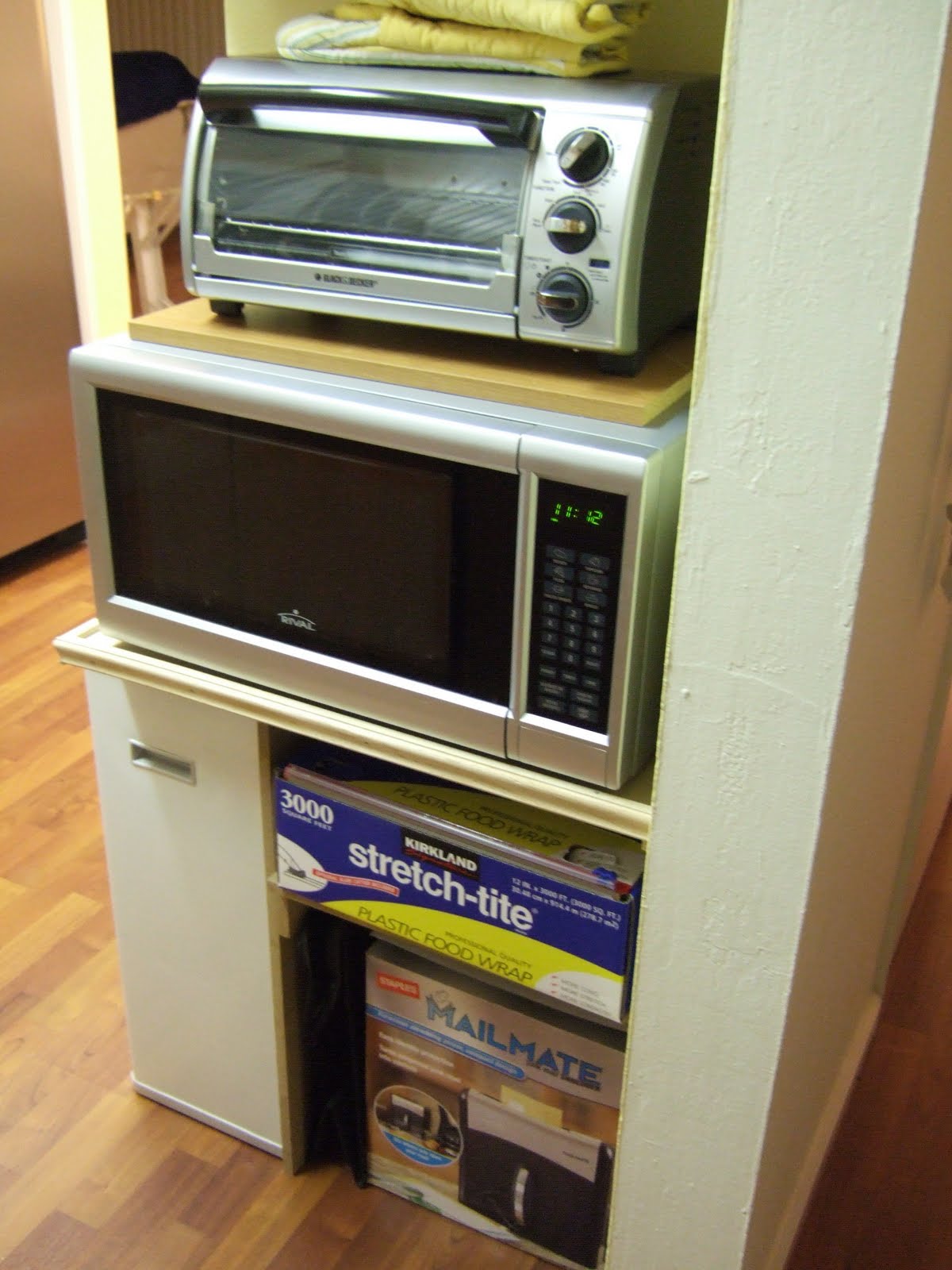
Also, to clear up already-limited countertop space for cooking, Tung and his dad build this standing shelf for the microwave, toaster oven, plastic-wrap container, and the Asian household staple, the rice box.

Notice the clean use of vertical space:


I put together this shoe rack, all by myself! Well, it was one of those easy "no tools required" assemblies, plus I was trying to do my due diligence as a Tech Writer by reading the instructions, when in the middle of my RTFM moment, Tung wanted to take over, but aside from his assembly of one of the legs, I did do the rest by myself. So do I look like an old lady with her shoe rack support here?
Here's Tung's "Awww, why does Daisy make me work on house stuff on my weekends all the time" face:

Yes, he's thrilled to be assembling storage units. Anyway, off to work.

I was told two-and-a-half hours later when I returned to the house from a few errands that this particular cabinet was put together with a more-than-normal amount of cussing due to the stupidity of the way the instructions were written--which were later ripped to tidbits due to spite. Something about the confusion with the "top shelf" and "static shelf" so that the tally of hours Tung spent on it went approximately like thus:
1 hour: partial assembly
0.5 hours: cussing over mixing up the two shelves
1 hour: taking apart mistake and re-assembling
Well, we can't all have our Tech Writer girlfriends write up our instruction manuals, now, can we?
So here's a shot of our ghetto-rigged phone table before: one of our moving boxes that looked like it was barfing multi-colored electric cables all over itself while it crapped shoes on the floor.

Here's the "After" shot of the (aforementioned pain-in-the-butt) cabinet/phone table. Yes, I still use a land phone.

And the shoes are neatly stored on my new shoe rack.

Here's the "Before" shot of what happens when you've got no place to put your media.

Viola! New shelf built for music and movie library, plus a media cabinet for the stereo, VCR/DVD player, Playstation, and soon-to-be Wii console. Still kinda messy with the wires, but in due time, when I can get Tung to make another "why do I have to do this" face, we'll get that tidied up soon enough.

Also, to clear up already-limited countertop space for cooking, Tung and his dad build this standing shelf for the microwave, toaster oven, plastic-wrap container, and the Asian household staple, the rice box.

Notice the clean use of vertical space:
Friday, June 11, 2010
The Ghost of Aikido Future
The Ghost of Aikido Present reminds me that I need to get to the dojo to take ukemi for a classmate’s 5th-kyu test. We’ve practiced for a few weeks, and I keenly feel that pressing responsibility to be there for him. Time ticks by on the clock, and yet my boyfriend’s family insists that I go clothes shopping with them. “It’ll only take a little while,” they assure me. “You’ll definitely make it there in time.” We waft past meaningless rows of fresh new clothes on hangers, and while they pick out their choices to try on, I impatiently tap my toes, waiting for them to be finished.
The Ghost of Aikido Past finds me back at my house when class is about to start. Reaching panic mode, I grab my car keys and dash for the door, only to come to the realization that the dojo is not located near my workplace but is for some reason part of the San Jose State University campus where I used to train. So used to the world of an interior wrestling gym that is my current dojo, I had forgotten the old place—proud sequoias standing tall, lush leaves blanketing the second-story dojo windows in shade; sunlight streaming through the branches, and the crisp, clean-straw smell of the Zebra mats. Only one problem with the SJSU dojo: last-minute parking on campus is usually next-to-impossible. “It’s ok,” my boyfriend reasons, “your classmate will find another uke. There’s no way you’ll get there in time.” Dismayed, I realize he’s right as I glance at the clock. By the time I manage to find parking, class would probably be over.
The Ghost of Aikido Future whispers in my ear that not only have I failed as an uke and have broken my promise to be there, I am going to miss the Black-Belt Demos put on by the yudansha. In our dojo, the different belt classes rotate every month to perform a demo of material on each of our next tests, and Black-Belt Demos are especially fun to watch because of the intensity, artfulness, and technical precision of the techniques. “No!” I think as the images whirl to abyss, “Not the demo! Please, just give me this day back. I need to do it differently. I need to re-live the day.”
And that was when I woke up a la Ebenezer, a beautiful new day to greet me with birds chirping outside my window. It was still another three days until test day at the dojo—I had the day back and then some. There’s a moral in this, aside from an unnecessary reminder of how much aikido means to me, aside from an irrational ukemi anxiety, aside from the haunting frustration of not knowing where to put my car after I arrived to my former college campus full of memories. And, yes, even aside from the petrifying nightmare of missing the chance to see a Black-Belt Demo. So often, our dreams blow the smaller things out of proportion until they seem unmanageable and out of control. Those dreams of falling as you wake with a start upon impact with the cold, hard asphalt. Those dreams of driving normally until you suddenly realize your brakes are out as your car skids downhill and gathers momentum. Those dreams of “I can’t” and “I won’t” replacing the possible reality of “I could” and “I will.”
It’s true—training four days at the dojo, using my vacation time to train some more at an aikido camp, and coming home to late-night dinners—don’t leave much time left over for a social or family life. Sometimes, the guilt sets in; I know I should try to tear myself away from the dojo before dark, reserve my weekends for something other than keiko and weapons class for half the morning. But the Ghost of Aikido Future is hinting to me that even if I reverse my priorities, that sense of guilt doesn’t go away. It’s just a different kind of guilt, and another kind of unhappiness. And it also tells me that I need a new perspective on things. I need to stop making the aikido and the personal go through a tug-of-war for my time and attention. Like rivaling siblings, they need to learn to co-exist, to get along, and to even like it. Because they both make up the most essential and the best parts of me. Because I need to stop thinking, “Aikido in my life,” but more like, “Aikido is my life.”
The Ghost of Aikido Past finds me back at my house when class is about to start. Reaching panic mode, I grab my car keys and dash for the door, only to come to the realization that the dojo is not located near my workplace but is for some reason part of the San Jose State University campus where I used to train. So used to the world of an interior wrestling gym that is my current dojo, I had forgotten the old place—proud sequoias standing tall, lush leaves blanketing the second-story dojo windows in shade; sunlight streaming through the branches, and the crisp, clean-straw smell of the Zebra mats. Only one problem with the SJSU dojo: last-minute parking on campus is usually next-to-impossible. “It’s ok,” my boyfriend reasons, “your classmate will find another uke. There’s no way you’ll get there in time.” Dismayed, I realize he’s right as I glance at the clock. By the time I manage to find parking, class would probably be over.
The Ghost of Aikido Future whispers in my ear that not only have I failed as an uke and have broken my promise to be there, I am going to miss the Black-Belt Demos put on by the yudansha. In our dojo, the different belt classes rotate every month to perform a demo of material on each of our next tests, and Black-Belt Demos are especially fun to watch because of the intensity, artfulness, and technical precision of the techniques. “No!” I think as the images whirl to abyss, “Not the demo! Please, just give me this day back. I need to do it differently. I need to re-live the day.”
And that was when I woke up a la Ebenezer, a beautiful new day to greet me with birds chirping outside my window. It was still another three days until test day at the dojo—I had the day back and then some. There’s a moral in this, aside from an unnecessary reminder of how much aikido means to me, aside from an irrational ukemi anxiety, aside from the haunting frustration of not knowing where to put my car after I arrived to my former college campus full of memories. And, yes, even aside from the petrifying nightmare of missing the chance to see a Black-Belt Demo. So often, our dreams blow the smaller things out of proportion until they seem unmanageable and out of control. Those dreams of falling as you wake with a start upon impact with the cold, hard asphalt. Those dreams of driving normally until you suddenly realize your brakes are out as your car skids downhill and gathers momentum. Those dreams of “I can’t” and “I won’t” replacing the possible reality of “I could” and “I will.”
It’s true—training four days at the dojo, using my vacation time to train some more at an aikido camp, and coming home to late-night dinners—don’t leave much time left over for a social or family life. Sometimes, the guilt sets in; I know I should try to tear myself away from the dojo before dark, reserve my weekends for something other than keiko and weapons class for half the morning. But the Ghost of Aikido Future is hinting to me that even if I reverse my priorities, that sense of guilt doesn’t go away. It’s just a different kind of guilt, and another kind of unhappiness. And it also tells me that I need a new perspective on things. I need to stop making the aikido and the personal go through a tug-of-war for my time and attention. Like rivaling siblings, they need to learn to co-exist, to get along, and to even like it. Because they both make up the most essential and the best parts of me. Because I need to stop thinking, “Aikido in my life,” but more like, “Aikido is my life.”
Friday, June 4, 2010
Gasshuku
“We can just work on getting a good backstretch for now.”
“That isn’t working, so you’ll have to do it another way. Push from your center, turn from your hips.”
“I know—it’s hard because he’s big, isn’t he?”

They were random bits of advice, sympathy, and encouragement from various training partners whom I’d paired up with during a three-day training camp, a “gasshuku” held annually at North Lake Tahoe. This year, I attended my first—full of fun, educational experiences, and surprises, including the fact that those kernels of advice each came from a Sensei whom I didn’t know was a Sensei when I trained with them. There were so many aikidoka packed on the mat; often, we could not even fully do a sit-fall. They came from California, Texas, Arizona, Virginia, Germany—all over the world map to meet in one common area and practice a common language: that of aikido.

My Sensei said we do aikido not so much with our ears but with our eyes, and though we may not all understand each other, aikido is the one language that we speak together. We bow in. We merge energies, clash wooden weapons, thank each other, bow out. We do it for a total of three days: 14 cumulative training hours at 6,000-feet elevation in an average of 30-50-degree weather marking one of the unusually cool, late-May summers near the beautiful, pristine lake.

Being so close to nature, away from the comforts and familiarity of home, we practice that common and old language of aikido. We teach each other and encourage each other to explore new terrain. I awake to birds chirping in the morning, take in lung-fulls of the thin but clean air. I pace the pier that leads to the lake’s depths, see the snow-capped mountains outlined in the glassy surface of the water.

I walk by acorns on the ground with their sweet kernels blooming wide open. To me, all these things are aikido. They are emblematic of beauty, peace, harmony: pristine nature reflected in a pure and true art. I hold these images in my heart as I train, ready to break out of my shy shell and open up like a flower, tendrils reaching out and exploring what each new stranger of a training partner has to teach me, offering my new, full heart to them and wondering if they can also see what I see.

At the end of the three days, my mind spun from all the new things I had seen, practiced, and learned. My jo bore new pockmarks from impact with its bokken cousin. Every inch of my body hurt, and muscles I didn’t know I had started throbbing. And yet, I felt great, flying high from adrenaline and a sense of accomplishment. We formed a “closing circle” to end the seminar, each person stating a single word they took out of the gasshuku. I heard “Friends,” “Fun,” “Awareness,” “Connections,” “Amazed.” It was a weekend full of firsts, this journey to a new world of training camp that left me in awe and at a loss for words. I hope to revisit this world again and reach out exploratory tendrils to whatever else the bigger universe has yet to show me.

“That isn’t working, so you’ll have to do it another way. Push from your center, turn from your hips.”
“I know—it’s hard because he’s big, isn’t he?”

They were random bits of advice, sympathy, and encouragement from various training partners whom I’d paired up with during a three-day training camp, a “gasshuku” held annually at North Lake Tahoe. This year, I attended my first—full of fun, educational experiences, and surprises, including the fact that those kernels of advice each came from a Sensei whom I didn’t know was a Sensei when I trained with them. There were so many aikidoka packed on the mat; often, we could not even fully do a sit-fall. They came from California, Texas, Arizona, Virginia, Germany—all over the world map to meet in one common area and practice a common language: that of aikido.

My Sensei said we do aikido not so much with our ears but with our eyes, and though we may not all understand each other, aikido is the one language that we speak together. We bow in. We merge energies, clash wooden weapons, thank each other, bow out. We do it for a total of three days: 14 cumulative training hours at 6,000-feet elevation in an average of 30-50-degree weather marking one of the unusually cool, late-May summers near the beautiful, pristine lake.

Being so close to nature, away from the comforts and familiarity of home, we practice that common and old language of aikido. We teach each other and encourage each other to explore new terrain. I awake to birds chirping in the morning, take in lung-fulls of the thin but clean air. I pace the pier that leads to the lake’s depths, see the snow-capped mountains outlined in the glassy surface of the water.

I walk by acorns on the ground with their sweet kernels blooming wide open. To me, all these things are aikido. They are emblematic of beauty, peace, harmony: pristine nature reflected in a pure and true art. I hold these images in my heart as I train, ready to break out of my shy shell and open up like a flower, tendrils reaching out and exploring what each new stranger of a training partner has to teach me, offering my new, full heart to them and wondering if they can also see what I see.

At the end of the three days, my mind spun from all the new things I had seen, practiced, and learned. My jo bore new pockmarks from impact with its bokken cousin. Every inch of my body hurt, and muscles I didn’t know I had started throbbing. And yet, I felt great, flying high from adrenaline and a sense of accomplishment. We formed a “closing circle” to end the seminar, each person stating a single word they took out of the gasshuku. I heard “Friends,” “Fun,” “Awareness,” “Connections,” “Amazed.” It was a weekend full of firsts, this journey to a new world of training camp that left me in awe and at a loss for words. I hope to revisit this world again and reach out exploratory tendrils to whatever else the bigger universe has yet to show me.

Friday, May 14, 2010
Playing with the Big Boys
A little more than halfway through third kyu, and suddenly everything is new again. Footwork, body angles, where the hands go—I am revisiting the minor details of these movements, nitpicking to get them right. In regular keiko, sandwiched in the middle at lineup between beginners and yudansha, I had grown accustomed to training with students near my rank or lower, our pace steady as we work through and try to understand the techniques. I become the middle child, surrounded by big brothers and little sisters, for the most part overlooked and ignored.
Sensei writes me an email: “So when are you going to attend Advanced Training?” Held on Mondays and Fridays for half an hour after regular keiko, or Wednesdays for the full hour, Advanced Training is something I’ve always sat on the sidelines to observe since I joined the dojo. There are those students who first join the sessions and struggle with the newness and intensity, but for the most part, it consists of yudansha going at each other at full speed and strength. Sometimes, there is advanced weapon techniques, including take-aways like jo- and tachi-dori. Often, it includes lessons on reversals, how to morph ikkyo omote into sankyo ura, or yonkyo into a kokyu-ho throw. Therefore, it is a joy to watch, and a pleasure for the senses to see aikido at a natural pace, practiced by partners who look like they dance through the techniques with fluidity and simplicity.
I write Sensei back: “I know I’m overdue to join the advanced sessions; I am in transition after having just moved houses; work has picked up; life got busy.” It’s all true, but I know a part of me is still hanging onto the desire to sit and watch. It’s easier to do when I wasn’t yet qualified and didn’t have the choice of joining in. But Sensei has a no-nonsense attitude and presses me about it when I next see her. So on the following Monday, I join the meager Advanced group and clap to bow in to training a second time that night. Pushed pass the comfortable safety of the sidelines, I find myself encompassed by the yudansha training circle. The entire, vast mat is our playground; with just the five of us, we are not packed tightly like a regular, busy keiko, watching where we throw and land, keeping our training partners falling within the borders of the mat, trying not to slide off during a pin. And yet the advanced techniques are more refined, the spirals tighter, the circular footwork confined and neat.
For the most part of that first session, I struggle. I hear loud ki-ai’s and grunts and heavy thwacks of bodies on the mat as the more advanced students are training on the opposite end. I throw my full strength into a technique, trying to move my partner. The pace gets quicker, and I use the precious moments when a new technique is being demonstrated to sit in seiza and catch my breath. Even ikkyo becomes more intricate as Sensei points out the angles, showing how my sloppy movements can leave me wide open for a good punch to the ribs. She reiterates ma-ai, committed attacks, the importance of using my hips.
Life is changing. I just moved into the first house I ever bought, started managing the small team I’ve built at work over the past few years, and began the Advanced Training sessions. I am moving past being the middle child, starting to play with the big boys. And because these challenges are part of what makes a fulfilling life, I step off the sidelines, take my plunge into the Advanced circle, and ready myself in hanmi to face the next thing that comes at me.
Sensei writes me an email: “So when are you going to attend Advanced Training?” Held on Mondays and Fridays for half an hour after regular keiko, or Wednesdays for the full hour, Advanced Training is something I’ve always sat on the sidelines to observe since I joined the dojo. There are those students who first join the sessions and struggle with the newness and intensity, but for the most part, it consists of yudansha going at each other at full speed and strength. Sometimes, there is advanced weapon techniques, including take-aways like jo- and tachi-dori. Often, it includes lessons on reversals, how to morph ikkyo omote into sankyo ura, or yonkyo into a kokyu-ho throw. Therefore, it is a joy to watch, and a pleasure for the senses to see aikido at a natural pace, practiced by partners who look like they dance through the techniques with fluidity and simplicity.
I write Sensei back: “I know I’m overdue to join the advanced sessions; I am in transition after having just moved houses; work has picked up; life got busy.” It’s all true, but I know a part of me is still hanging onto the desire to sit and watch. It’s easier to do when I wasn’t yet qualified and didn’t have the choice of joining in. But Sensei has a no-nonsense attitude and presses me about it when I next see her. So on the following Monday, I join the meager Advanced group and clap to bow in to training a second time that night. Pushed pass the comfortable safety of the sidelines, I find myself encompassed by the yudansha training circle. The entire, vast mat is our playground; with just the five of us, we are not packed tightly like a regular, busy keiko, watching where we throw and land, keeping our training partners falling within the borders of the mat, trying not to slide off during a pin. And yet the advanced techniques are more refined, the spirals tighter, the circular footwork confined and neat.
For the most part of that first session, I struggle. I hear loud ki-ai’s and grunts and heavy thwacks of bodies on the mat as the more advanced students are training on the opposite end. I throw my full strength into a technique, trying to move my partner. The pace gets quicker, and I use the precious moments when a new technique is being demonstrated to sit in seiza and catch my breath. Even ikkyo becomes more intricate as Sensei points out the angles, showing how my sloppy movements can leave me wide open for a good punch to the ribs. She reiterates ma-ai, committed attacks, the importance of using my hips.
Life is changing. I just moved into the first house I ever bought, started managing the small team I’ve built at work over the past few years, and began the Advanced Training sessions. I am moving past being the middle child, starting to play with the big boys. And because these challenges are part of what makes a fulfilling life, I step off the sidelines, take my plunge into the Advanced circle, and ready myself in hanmi to face the next thing that comes at me.
Subscribe to:
Posts (Atom)