A little more than halfway through third kyu, and suddenly everything is new again. Footwork, body angles, where the hands go—I am revisiting the minor details of these movements, nitpicking to get them right. In regular keiko, sandwiched in the middle at lineup between beginners and yudansha, I had grown accustomed to training with students near my rank or lower, our pace steady as we work through and try to understand the techniques. I become the middle child, surrounded by big brothers and little sisters, for the most part overlooked and ignored.
Sensei writes me an email: “So when are you going to attend Advanced Training?” Held on Mondays and Fridays for half an hour after regular keiko, or Wednesdays for the full hour, Advanced Training is something I’ve always sat on the sidelines to observe since I joined the dojo. There are those students who first join the sessions and struggle with the newness and intensity, but for the most part, it consists of yudansha going at each other at full speed and strength. Sometimes, there is advanced weapon techniques, including take-aways like jo- and tachi-dori. Often, it includes lessons on reversals, how to morph ikkyo omote into sankyo ura, or yonkyo into a kokyu-ho throw. Therefore, it is a joy to watch, and a pleasure for the senses to see aikido at a natural pace, practiced by partners who look like they dance through the techniques with fluidity and simplicity.
I write Sensei back: “I know I’m overdue to join the advanced sessions; I am in transition after having just moved houses; work has picked up; life got busy.” It’s all true, but I know a part of me is still hanging onto the desire to sit and watch. It’s easier to do when I wasn’t yet qualified and didn’t have the choice of joining in. But Sensei has a no-nonsense attitude and presses me about it when I next see her. So on the following Monday, I join the meager Advanced group and clap to bow in to training a second time that night. Pushed pass the comfortable safety of the sidelines, I find myself encompassed by the yudansha training circle. The entire, vast mat is our playground; with just the five of us, we are not packed tightly like a regular, busy keiko, watching where we throw and land, keeping our training partners falling within the borders of the mat, trying not to slide off during a pin. And yet the advanced techniques are more refined, the spirals tighter, the circular footwork confined and neat.
For the most part of that first session, I struggle. I hear loud ki-ai’s and grunts and heavy thwacks of bodies on the mat as the more advanced students are training on the opposite end. I throw my full strength into a technique, trying to move my partner. The pace gets quicker, and I use the precious moments when a new technique is being demonstrated to sit in seiza and catch my breath. Even ikkyo becomes more intricate as Sensei points out the angles, showing how my sloppy movements can leave me wide open for a good punch to the ribs. She reiterates ma-ai, committed attacks, the importance of using my hips.
Life is changing. I just moved into the first house I ever bought, started managing the small team I’ve built at work over the past few years, and began the Advanced Training sessions. I am moving past being the middle child, starting to play with the big boys. And because these challenges are part of what makes a fulfilling life, I step off the sidelines, take my plunge into the Advanced circle, and ready myself in hanmi to face the next thing that comes at me.
Friday, May 14, 2010

Wednesday, May 5, 2010
Unpacking
It’s quiet in the mornings, the only sounds the chirping of different varieties of birds nested in the nearby trees. Once in a while, the heat clicks before running its course through the house, or the refrigerator unloads another batch of ice down the chute. Not the sounds of deep bass pumping from oversize stereos of cars passing by, bad brakes squealing, or children yelling on their way to the nearby elementary school.
Cardboard boxes lay strewn about the house, containing remnants of my past: stuffed animals from my girlhood, files of paper from my academic years, trinkets and decorations waiting for a new home. They are coated with the dust of time, the thin motes and particles swirling like eddies in the sun-slanted air as I lift these items from their boxes. I unwrap the music boxes from my hasty newspaper padding, protection during transportation. Slowly, I wind up the switches. Nothing dredges up remembrances like music; the clear, sweet notes tinkle through the air, echoing off the empty walls of the house and tugging at the memories in my heart. There is “Love Me Tender” from the very first music box my mother gave me on my birthday when I was a little girl, with two magnetic swans circling on the mirrored surface. There is “Blue Danube” from a tiny music box I once bought myself. There is “Love Story,” a gift from a former date. And then there is “Younger Than Springtime,” a Christmas gift when Tung and I had first started going out.
One of my professors once told me, “Everyone, at one point or another in their lives, must get acquainted with loneliness.” I waft through the rooms of my new house, feeling homesick for my old one. As I put unboxed things in their rightful places, I feel the loneliness keenly, embracing it to come to terms with it, and to learn how to move on.
These smells that hover in some of the rooms, they are not mine. They are of some stranger’s past life, so familiar to her that she had grown accustomed and eventually did not notice them at all. I step into a room and am assaulted by the unfamiliarity of the scent. I gradually chase out these foreign smells with my subtle perfumes, and the steamy aroma of shampoo, conditioner, body wash, mousse, and lotions. I bask the kitchen that first weekend in the smell of sautéing vegetables and shrimp, of garlic browning in a pan of oil, of onions running clear before I throw on the ground beef—the comforting scents of home cooking.
Whereas before I became comfortable in the small sphere of my own room, now I have an entire house to tend. My world just got bigger. Every room calls for my attention, and I think of ways to furnish them, decorate them, maximize space. There’s much more to clean, but also more to enjoy. “Hello, house,” I think as I unpack, “I live here. I am your master now.” I’ve tamed the old roof, the broken fence, the burst pipe, the rotted window, the water reflux from the drainage clog. Now, I stack pans in cupboards, slide books on shelves, throw fresh sheets on the beds, and lay claim to what’s finally mine.
Tuesday, April 27, 2010
Masochist
I can't remember the last time I bought new clothes for myself, what with the repairs to the recently-purchased house diminishing my lifetime's worth of savings little by little. But out of what I told myself is a necessary investment, I bought two new gi at a local Japanese martial-arts supply store--first one because I wanted a heavyweight gi, and then another lightweight gi out of spite because the store announced a sale the week I came back to pick up my heavyweight one that finally came in from special order. There would probably be no room in the closet, and I could have used that money for something else--like food. But, really, I couldn't help it. It felt like the thing to do.
The clerk who took my order unraveled the two crisp, white cotton jackets after I took them out of their plastic bags, and I could see she was wondering, "What the heck are these?" I'm sure she's seen her fair share of strange apparel, having worked at this embroidery shop for a while. These are not your typical t-shirts to be silk-screened, or polo shirts to be embroidered with the company logo, or even baseball caps to be tagged for a sense of team unity.
"I want my first name embroidered on the left sleeves," I told her, handing over my gi tops.
When a different clerk from the embroidery shop handed me back the processed order, now with my name etched in neat black thread, I could see him eying the many bruises along my forearms. There were the bigger, most prominent bruises from taking ukemi for yonkyo practice, blackish-green to blue, their telltale hues a color code indicating where along the week I got them. There was the newborn reddish bruise at the base of the ulna bone on my left wrist from blocking yokomenuchi strikes. There were the thumb-sized bruises at the forearm base from the tight tai-no-henko grips. There was also the bruise on the inner right knee from my bad footwork, and the stubbed toe coming up from a roll. And, though he couldn't see this, I could feel the hyper-extension of my left elbow from a full day of kokyu nages.

Part of me knows this is my body's usual way of protesting a year's worth of almost-daily abuse. It's the same part of me that fears the pain--a reminder of my mortality, the paranoia that I'll undergo a permanent and irreversible injury I'm bound to regret. But most days, it's this pain that wakes me up, that reminds me how I'm alive to feel it. It's this urge that sends me flying to the dojo almost everyday after work, this instinct that guides my feet back on the mat even when I think I'm tired or lazy or that I don't want to train. I learn to take the pain and give it, to heal from it only to receive it again. Part of me thinks I am crazy and knows that the litany of bruises do not go well with the inevitable short-sleeve outfits of the coming summer. But, really, I can't help it. It feels like the thing to do.
Wednesday, April 21, 2010
Calligraphy

The shomen displays the characters of "ai-ki-do," and I study it every day I sit in seiza during line-up, waiting for Sensei to bow us in. There is the "ai," like a little house with a teepee roof, the point meeting at the very tip, like merging energy. The roof curves delicately down, flaring out at the ends with slight pressure on the brush, the different personalities of two separate energies. Under the roof are the square walls of the house: solid, contained, united.
The lower-left corner of the "ki" character explodes like a flower's pistil, contained energy topped by a right-angle bracket that trails off towards the heavens like incense smoke. First solid and then steam, the ebb and flow of "life force."
The "do" is a man on a path. I cannot see what's behind or ahead of him, only know that he travels, the road beneath his feet straight and open, extending off to the white horizon of distant unknowns in his journey to find "the way."
There is a smoothness in these strokes, a flow that I try to mirror as I train. When practicing with yudansha, I can feel their energy--persistent steadiness to draw out uke's attack, explosive strength during the climactic take-down, then measured control for the pin. As I work my way through not-yet-familiar techniques, I know where I am cutting off my own energy, during a turn or when changing hands into the correct hold, like a calligraphy brush that has been cut off from its supply of ink. Day after day, I will continue to hone these skills, practicing my strokes, making them smooth and even, releasing and controlling energy where it counts, until I can coax the art to come out of my movements.
Monday, April 12, 2010
Taming the Tiger
I am drained. There are no lines left in my planner to fit in another “to-do.” Weekdays, work. Weeknights, work. Weekends, house work, feeling not much closer to moving in than when we bought the house in December. Between 9- or 10-hour workdays, dinners at 10:00pm, house maintenance and repairs, and falling asleep on the laptop over some random work project toted home, there is the training—wedged in between the everyday chaos like an ephemeral oasis of stress relief. For an hour of keiko, possibly another hour of extra practice, the world is calm. Crazy escalations don’t suddenly arise; ideas, thoughts, snippets of rushed conversation do not whiz by in a whirlwind of meaningless turbulence. Sure, there is the frustration of not getting a technique right, the lack of ability to do something, the constant desire to attain grace and flow in my movements. But mostly, there is just the sound of training, and the moment. When you are in the moment, the moment is all there is.
It is the Eastern zodiac Year of the Tiger. A year for taking action, embodied by a beast possessing immense energy. What can I do to tame the tiger? The need to be on the hunt, to move non-stop, to always be on guard, saps my will. I grow dry to the core, feeling like I’ve got nothing else to give to its incessant demands. “Aikido is like walking,” Sensei once told me. As simple as that, putting one foot in front of the other, the techniques thought out and tested to make the footwork adhere to movements most natural to the human body. At first you fumble, analyze, maybe even trip over your own feet. It’s hard, too much is going on, you can’t keep track of it all, feel like giving up. But then you remember the basics, the fundamentals of putting one foot in front of the other. Because in aikido, and in life, sometimes that’s all there is left to do.

It is the Eastern zodiac Year of the Tiger. A year for taking action, embodied by a beast possessing immense energy. What can I do to tame the tiger? The need to be on the hunt, to move non-stop, to always be on guard, saps my will. I grow dry to the core, feeling like I’ve got nothing else to give to its incessant demands. “Aikido is like walking,” Sensei once told me. As simple as that, putting one foot in front of the other, the techniques thought out and tested to make the footwork adhere to movements most natural to the human body. At first you fumble, analyze, maybe even trip over your own feet. It’s hard, too much is going on, you can’t keep track of it all, feel like giving up. But then you remember the basics, the fundamentals of putting one foot in front of the other. Because in aikido, and in life, sometimes that’s all there is left to do.
Wednesday, April 7, 2010
Waxing
In fifth grade, we made candles in Mr. Tenney's class, tying a white string on a yellow Number 2 pencil and taking turns to dip the string into a huge vat of simmering wax at the back of the classroom. We did this over several days, resting the pencils on metal racks so the wax could cool and later be re-dipped. I watched my maroon-colored candle slowly get thicker as the days passed. The finished product came out crooked, shaped more like an hour glass that curved in at the middle. Throughout the project, I learned to refine my candle-making skills, to dip quickly and pull the string straight back up instead of letting it sit in the boiling wax. I learned to dip lower and lower on the string as the girth of the candle grew to create a pointed tip at the top of the candle for easy lighting. And I learned that patience eventually yields a product I could be proud of, and could use.
In class, training partners I've practiced with in the past, as well as newer students, tell me, "You're getting stronger," or, "I think you're strong." My first reaction has always been to look at them with this shocked expression on my face. Growing up, I had never been strong. I had inherited my mother's small frame, her petite height, her thin bone structure. My grandpa used to observe, "You eat like a kitten--so little, small bites!" My grandma used to refer to my skinny arms as "frail chicken wings." During training, I thought the only thing I had going for me was my speed and my stubborn endurance; I never thought I had strength. So it surprises me to realize that my grip is getting stronger, my attacks more committed, my pins more convincing. That I am learning to use the power in my hips, putting my feet in the right places, trusting myself enough to not look at my partner to make sure I've got him or her in the right position.
The months pass. The dojo turns from sweltering-hot to bitingly-cold to a mild, comfortable temperature with the spring sun slanting in just right from the windows overhead. The moon waxes, growing slivers of layers until it becomes round and full, big and noticeable. Like the layers of my candle, once unrecognizable, then transforming into something useful. I am waxing, refining my techniques--building strength slowly, gaining confidence gradually, until one day I am able to see things that weren't there before.
Sunday, April 4, 2010
Painting
Past fumigation, a leaking ABS pipe, a shower head not attached to the tile wall, a crumbling window frame due to water damage, lack of a dryer duct vent, a noisy garbage disposal, a leaking gas pipe, a collapsed fence, a cracked skylight, and an old roof with two layers on it, we now tackle a bit more conventional home-renovation project: repainting.

We masked and covered all extra appendages that couldn't be taken out of the bathrooms.

My brother Johnny and his girlfriend, Duong came over to help us repaint. Davis kids--so efficient.
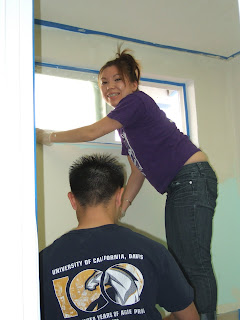
Covering up the old paint. . .

Yes, the previous bathroom walls were aquamarine. Dubbed "swimming pool" by Johnny, "parakeet blue" by my dad. We repainted them "Antique White."

Here's a shot of the guest bathroom showing the contrast between the white door and the Antique White shade.

The Master Bathroom.

The Master Bathroom shower stall.

The Master Bathroom after repainting. The Antique White highlights the white ceiling and blends with the cream-colored shower stall tiles.

The Master Bathroom window.
Before: We pulled away the drywall to reveal water damage from rain--nassssssty.
After: Fixed and repainted. Phew.

This room will be my office. The "Before" pale green is actually quite attractive, but c'mon. I've always wanted a lavender room.

Full shot of the repainted office. The color is "Winter Ice" in a flat matte.


We masked and covered all extra appendages that couldn't be taken out of the bathrooms.

My brother Johnny and his girlfriend, Duong came over to help us repaint. Davis kids--so efficient.

Covering up the old paint. . .

Yes, the previous bathroom walls were aquamarine. Dubbed "swimming pool" by Johnny, "parakeet blue" by my dad. We repainted them "Antique White."

Here's a shot of the guest bathroom showing the contrast between the white door and the Antique White shade.

The Master Bathroom.

The Master Bathroom shower stall.

The Master Bathroom after repainting. The Antique White highlights the white ceiling and blends with the cream-colored shower stall tiles.

The Master Bathroom window.
Before: We pulled away the drywall to reveal water damage from rain--nassssssty.
After: Fixed and repainted. Phew.

This room will be my office. The "Before" pale green is actually quite attractive, but c'mon. I've always wanted a lavender room.

Full shot of the repainted office. The color is "Winter Ice" in a flat matte.

Subscribe to:
Posts (Atom)